MedicalCertPrep
OET practice for health professionals.
Listening, Reading, Writing and Speaking in the published format. Felix, our AI marker, marks your letters and plays your patient. His result is an estimated grade, not an official one, and he does not judge pronunciation.



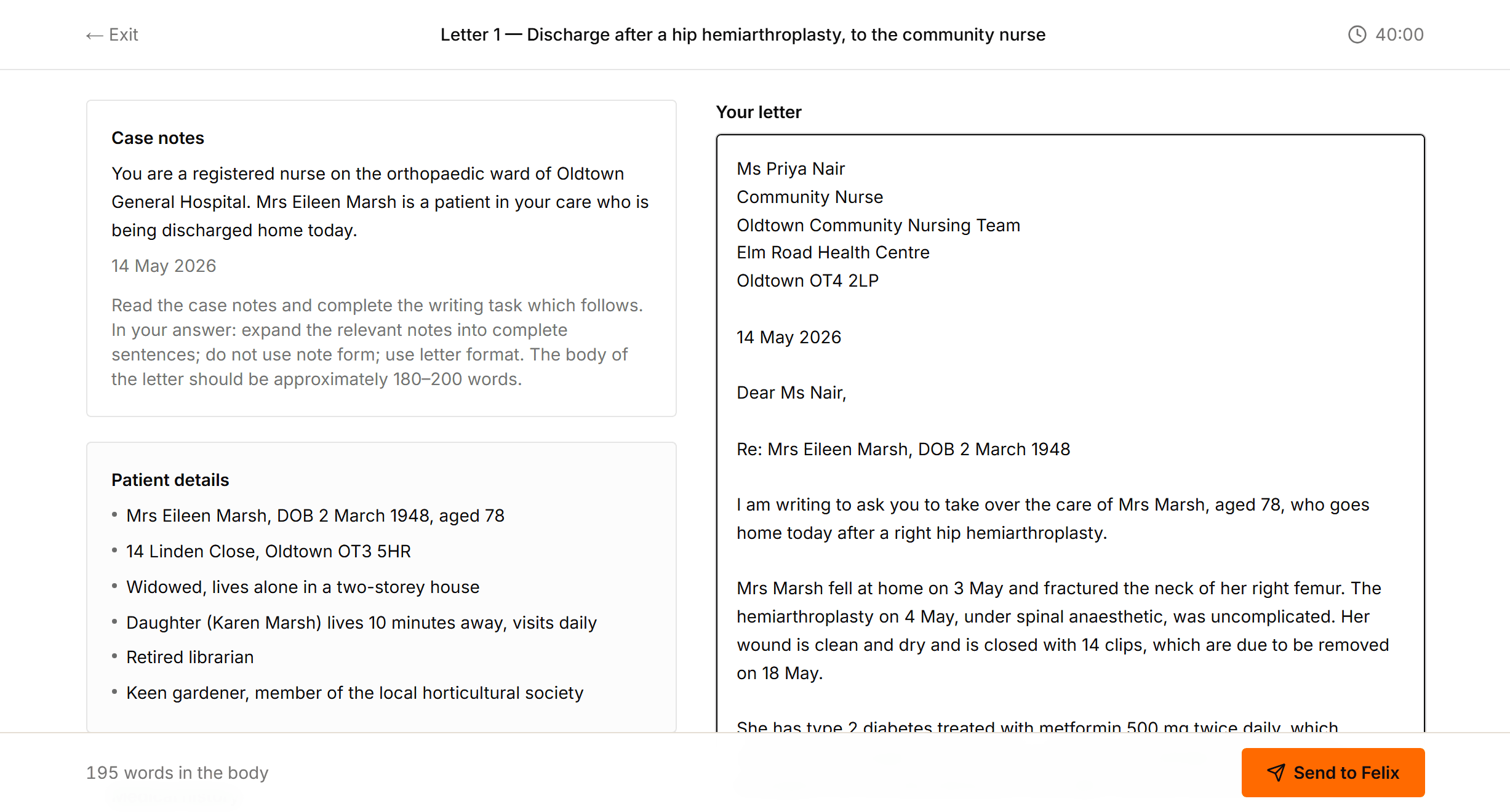

Writing — The letter · 180–200 words
Photos, cropped, via Wikimedia Commons: Almondbite3, CC BY-SA 4.0; U.S. Air Force, Tech. Sgt. Rachel Maxwell, public domain (no endorsement implied).
- 840
- exercises across the four sub-tests
- 350
- points make a grade B in a sub-test
- 12
- professions sit the OET
- 711
- candidates signed up
Look inside: real exercise screens from every sub-test

Listening and Reading are shared.
Writing and Speaking differ by profession.
The first two sub-tests are the same for all twelve professions. The letter you write and the role-plays you play depend on yours. Start with the sub-test you expect to be weakest, or with one free test to find out.

Pick a sub-test
Listening
Three parts, and each recording plays once. Complete a clinician’s notes, answer on short workplace extracts, follow a presentation.
Practise ListeningReading
Part A has its own fifteen minutes. Then Parts B and C: short workplace texts, and two long articles with four options a question.
Practise ReadingWriting
Read the case notes, decide what the reader needs, write the letter. Felix marks it on the six criteria.
Write a letterSpeaking
Three minutes with the role card, five with Felix as your patient. He marks what you say, not your pronunciation.
Try a role-play
Felix marks
your letters and
your role-plays.
He applies the six Writing criteria and, for Speaking, the criteria that can be judged from a transcript. You see short phrases from your letter quoted, the details you left out and the ones you did not need, and an estimated grade. He does not judge pronunciation.
A letter, marked on six criteria
Purpose, Content, Conciseness and Clarity, Genre and Style, Organisation and Layout, Language: each with the sentences it is based on.
A role-play, marked on what you said
Felix plays the patient and waits for your questions. Afterwards you see which communication skills he found in your words, and where he did not.
Where the exercises come from
Original exercises written to the published format. How they are made is on one page.
Not only the OET
Where are you going to work? Find the exam you will be asked to sit.
UK · Ireland · Australia
— The plan
26 exercises between you and your target.
Your target is 8 exercises of every Listening and Reading Part, and 5 letters and 5 role-plays at an average of 75% on Listening and Reading, at the solid setting. It is a preparation standard, not a prediction: nobody can tell you a number of exercises that earns a B.
Below is a worked example: a plan just over half done, five weeks before the test. Choose your profession, setting and test date, and the site draws this for you, recalculated with every exercise you finish.
Plan progress
55%
On track
Coverage and scores across the four sub-tests. This week’s share is done; anything more is buffer.
This week
6of 6
About 1 a day for the 35 days left. With a test date set, the total becomes a weekly share like this one.
Choose
your pass
Built around how long you have before the test: five days, six months or twelve months.
And no discount theatre: no countdown, no “70% off, ends tonight”. This is the everyday price, the same tomorrow as today.
- Everything marked against a key: every Listening and Reading exercise, with the recordings, and the question banks for DHA, DOH, MOHAP, SNLE, Nursing Technician, Qatar, Oman, Kuwait, Bahrain, SMLE, SPLE, CBT · UK
- Answers explained, question by question
- No Writing, Speaking or full tests, and no marking by Felix
- Listening and Reading in full; Writing and Speaking for every profession; the question banks for DHA, DOH, MOHAP, SNLE, Nursing Technician, Qatar, Oman, Kuwait, Bahrain, SMLE, SPLE, CBT · UK
- Every exam we open while your pass runs is included
- Full practice tests, timed as in the test
- Felix gives an estimated grade for your letters and role-plays
- Yours for 6 months: one payment, nothing renews
- Full refund within 30 days
- Listening and Reading in full; Writing and Speaking for every profession; the question banks for DHA, DOH, MOHAP, SNLE, Nursing Technician, Qatar, Oman, Kuwait, Bahrain, SMLE, SPLE, CBT · UK
- Every exam we open while your pass runs is included
- Full practice tests, timed as in the test
- Felix gives an estimated grade for your letters and role-plays
- Yours for 12 months: one payment, nothing renews
- Full refund within 30 days
The first two exercises of every Part, and one full test of each sub-test, stay free for everyone, with no card needed. See what is free.
Frequently
asked questions
What is the OET and who sits it?
The OET (Occupational English Test) is an English test for health professionals, set in clinical workplace situations and made up of four sub-tests: Listening, Reading, Writing and Speaking. Nurses, doctors, pharmacists, dentists and others in 12 professions sit it, usually because a regulator or an employer asks for a set grade.
Which grade do I need?
Typically grade B, which means a score of 350 or more, in each of the four sub-tests, though some regulators set a different minimum for Writing and an employer may set its own. Check your regulator's own page, because requirements change and this site cannot tell you yours.
Is it only for nurses?
No. The OET covers 12 professions: Dentistry, Dietetics, Medicine, Nursing, Occupational Therapy, Optometry, Pharmacy, Physiotherapy, Podiatry, Radiography, Speech Pathology and Veterinary Science. On this site all twelve are open: Listening and Reading are the same for every profession, and Writing and Speaking are written for yours.
Are these real OET sample tests?
No. Every exercise is written by us to the published format of the OET, with the same parts, question counts and timings, and none of it is copied from the OET's own sample tests. MedicalCertPrep is not affiliated with or endorsed by the owner of the OET.
How does Felix mark my letter?
Felix, our AI marker, marks it against the six published Writing criteria and quotes short phrases from your letter, each with a correction or a note. He also lists the details the case notes required that you left out and the unneeded details you included, then gives a profile of the criteria and an estimated grade: an estimate, not an official result, and never a score out of 500.
Does Felix mark my pronunciation?
No. Intelligibility, which covers pronunciation, intonation and rhythm, cannot be judged from a transcript, so Felix never marks it or gives you a pronunciation score. He does mark the other eight Speaking criteria from what you say: Fluency as far as a transcript shows it, Appropriateness of Language, Resources of Grammar and Expression, and the five clinical communication criteria.
What is free?
The first two exercises of every part are free, and so is one full test for each sub-test. Without a pass you can do up to three different exercises a day.
Can I practise on my phone?
Yes. The site runs in your phone's browser with nothing to install, and for Speaking you can type if your browser cannot turn speech into text. Your account is the same on every device, so you can practise on a break and sit a full test at a desk.
Do I need a microphone for Speaking?
No. You can speak or simply type your side of the conversation, and either way only the text reaches us: we never receive or store audio. If you speak, your browser's own speech recognition turns your voice into text, and which company handles that depends on your browser.